For over five centuries, the global economy has functioned on a system that is essentially a conversation between two private books. This is “double-entry” bookkeeping—a method where every transaction is recorded as a debit in one account and a credit in another. While this system, popularized by Luca Pacioli in 1494, was revolutionary for the Renaissance, it is struggling to keep up with the lightning-fast, decentralized nature of the 2026 digital economy. Today, we face a massive “trust gap.” Organizations spend billions of dollars and thousands of man-hours every year simply trying to prove that their version of the truth matches their partner’s version.
The shift toward a more transparent, mathematically verified system is no longer a luxury for tech startups; it is a foundational requirement for the future of global finance. As students enter this rapidly evolving field, the pressure to master emerging technologies like Distributed Ledger Technology (DLT) can be intense. Sometimes, the academic workload becomes so heavy that students look for reliable ways to do my assignment for me cheap using professional platforms like MyAssignmentHelp to ensure they stay ahead of their peers. Balancing these new technical concepts with traditional accounting principles is the only way to remain competitive in a job market that is moving toward total automation.
The Evolution: Why Double-Entry is No Longer Enough
To understand the leap to triple-entry, we must first look at the inherent flaw in the traditional model. In a double-entry world, Company A and Company B each maintain their own “siloed” ledgers. If Company A pays Company B for a shipment of goods, both parties record the transaction internally.
The problem is that these two records are not physically or digitally linked. To verify that the transaction actually happened as recorded, an outside auditor must step in. They have to manually compare Company A’s books with Company B’s books and then cross-reference them with bank statements. This process is slow, expensive, and—as seen in famous corporate scandals—highly susceptible to human error or intentional manipulation.
Enter Triple-Entry Accounting
Triple-entry accounting solves the “silo” problem by adding a third, shared component to the transaction. Instead of two separate entries that hope to match, a single, cryptographically signed transaction is written to a shared, public, and immutable ledger—the blockchain. This third entry acts as an indisputable “receipt” that is visible to both parties (and authorized auditors) in real-time.
| Feature | Double-Entry Bookkeeping | Triple-Entry (Blockchain) Accounting |
| Record Keeping | Two private, independent ledgers | Two private ledgers + One shared ledger |
| Trust Source | Third-party auditors/Banks | Cryptographic Proof / Network Consensus |
| Verification | Manual reconciliation (Weekly/Monthly) | Real-time, automated verification |
| Security | Vulnerable to internal alteration | Immutable (Cannot be changed after entry) |
| Transparency | Low (Hidden in private servers) | High (Accessible via authorized nodes) |
How Blockchain Powers the New Ledger
The “magic” behind triple-entry accounting is Distributed Ledger Technology (DLT). Think of the blockchain not just as a database, but as a living, breathing audit trail. When a transaction occurs, “Smart Contracts”—self-executing code stored on the blockchain—automatically check the rules. For example, a smart contract can verify if the buyer has sufficient funds and if the seller has delivered the digital “token” representing the goods.
Once the network of computers (nodes) agrees the transaction is valid, it is time-stamped and “hashed” into a block. This hash is a unique digital fingerprint. Because each block contains the hash of the previous block, they are mathematically chained together. If a dishonest employee tries to change a single digit in a transaction from three years ago, the fingerprints won’t match, and the entire network will instantly reject the change.
The Role of Real-Time Auditing
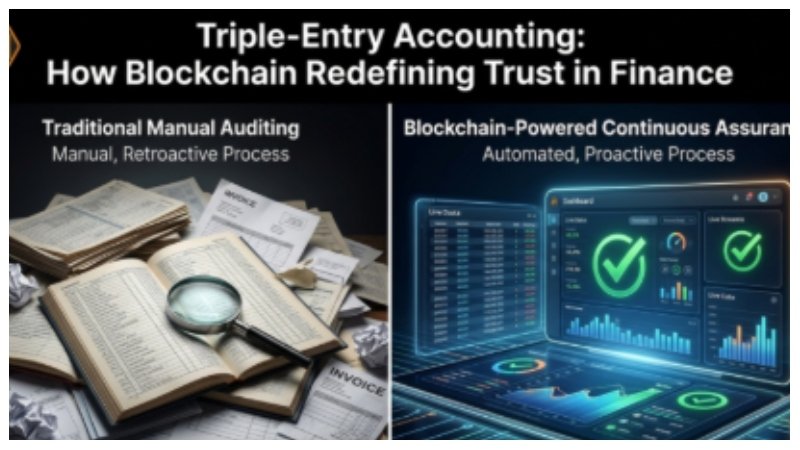
In the current financial world, the “Annual Audit” is a dreaded season. Companies hire massive teams to dig through boxes of receipts and digital logs to verify what happened over the last twelve months. It is a reactive, “after-the-fact” process. Triple-entry accounting turns this on its head by enabling Continuous Assurance.
Since the blockchain is a “single source of truth,” auditors no longer need to ask for permission to view records or wait for bank confirmations. They can simply plug into the ledger and see the financial health of a company at any given second. For those currently navigating these advanced frameworks in university, the complexity of moving from manual journals to cryptographic ledgers can be daunting. Many find that seeking specialized accounting assignment help is the best way to grasp how to structure these new audit trails and digital reports effectively. Mastering these concepts now is crucial, as the industry is moving away from the “once-a-year” checkup toward a model of constant, live transparency.
Why the Industry is Moving Toward “Continuous Assurance”
The “month-end close” is another tradition likely to disappear. Currently, accountants spend the first week of every month reconciling accounts and fixing discrepancies. In a world of triple-entry accounting, reconciliation is built into the transaction itself. There is nothing to “match” because both parties are looking at the exact same digital record.
This efficiency allows business leaders to make decisions based on live data. Imagine a CFO being able to see their exact cash flow, tax liability, and inventory value in real-time on a dashboard, without waiting for a report from the accounting department. This isn’t a futuristic dream; major ERP (Enterprise Resource Planning) providers like SAP and Oracle are already integrating blockchain “sidechains” to facilitate these instant reconciliations for global supply chains.
Managing Keyword Clusters for Future Accountants
To truly understand this field, students must be able to categorize information correctly. The following table represents how modern accounting knowledge is being “clustered” in 2026.
| Category | Key Concepts | Industry Application |
| Foundational Tech | DLT, Hashing, Consensus | Building secure financial networks |
| Smart Governance | Smart Contracts, DAOs | Automating payments and compliance |
| Data Integrity | Immutability, ZK-Proofs | Preventing fraud and protecting privacy |
| Regulatory Tech | Real-time Reporting, AML/KYC | Satisfying government tax requirements |
Overcoming the Challenges: Privacy and Scalability
While the benefits are clear, the road to global adoption has hurdles. The two biggest are Scalability and Privacy.
- Scalability: Public blockchains can be slow. If every coffee purchase in the world was on the main Bitcoin blockchain, the system would crash. To solve this, firms are using “Layer 2” solutions—fast, secondary networks that bundle thousands of transactions together before “settling” them on the main ledger once a day.
- Privacy: No corporation wants their competitors to see their specific profit margins or supplier costs. This is where Zero-Knowledge Proofs (ZKP) come in. ZKP allows a company to prove a transaction is valid (e.g., “We paid our taxes in full”) without revealing the specific numbers or names involved. It provides the “proof” without exposing the “private data.”
The Future Professional: The “Hybrid” Accountant
The accountant of the future is no longer a “bookkeeper” in the traditional sense; they are a Financial Systems Architect. The job is shifting from “entering data” to “verifying the code that enters the data.” Instead of checking a paper invoice, the modern accountant will audit the Smart Contract to ensure the code correctly calculates depreciation or international tax.
This hybrid role requires a deep understanding of both financial law and digital architecture. Students who can bridge the gap between these two worlds will be the most valuable assets in the job market. They won’t just be managing money; they will be managing the “Digital Trust” that allows global trade to function.
Conclusion: A New Era of Global Trust
Triple-entry accounting is far more than just a technical upgrade; it is a fundamental shift in how human beings interact with value. By using blockchain to create a shared, unchangeable record of truth, we can finally eliminate the friction, fraud, and delays that have plagued finance since the Middle Ages.
For students and professionals, the message is clear: the future of accounting is digital, transparent, and decentralized. While the transition from old-school ledgers to cryptographic chains may be complex, the reward is a financial system that is built on math rather than just promises. By embracing these changes today, you are not just learning a new tool—you are becoming a pioneer in the next era of global financial integrity.
Frequently Asked Questions
What exactly is triple-entry accounting?
It is an enhancement to traditional bookkeeping that adds a third, shared record to every transaction. This record is stored on a distributed ledger, creating a common “source of truth” that both the sender and receiver can verify instantly without manual reconciliation.
How does blockchain improve financial security?
Blockchain uses cryptography and a decentralized network to make records immutable. Once a transaction is confirmed, it cannot be altered or deleted without compromising the entire network, which effectively eliminates common types of internal data manipulation and fraud.
Does this system replace the need for auditors?
Rather than replacing them, it changes their role from manual data verification to real-time strategic oversight. Auditors can shift from checking past receipts to monitoring live data flows, allowing them to identify risks and systemic issues as they happen.
Can triple-entry systems handle private company data?
Yes. Modern frameworks use advanced privacy tools like zero-knowledge proofs. These allow organizations to prove that a transaction is valid and compliant without revealing sensitive details like specific profit margins or the identities of their suppliers to the public.
About The Author
Richard Russell is a dedicated content strategist and financial researcher with over a decade of experience in digital transformation. He specializes in bridging the gap between traditional fiscal principles and emerging technologies. Currently, Richard serves as a senior contributor for MyAssignmentHelp, where he focuses on delivering high-quality, data-driven insights to help the next generation of professionals navigate the complexities of modern industry standards. Click here for more information.